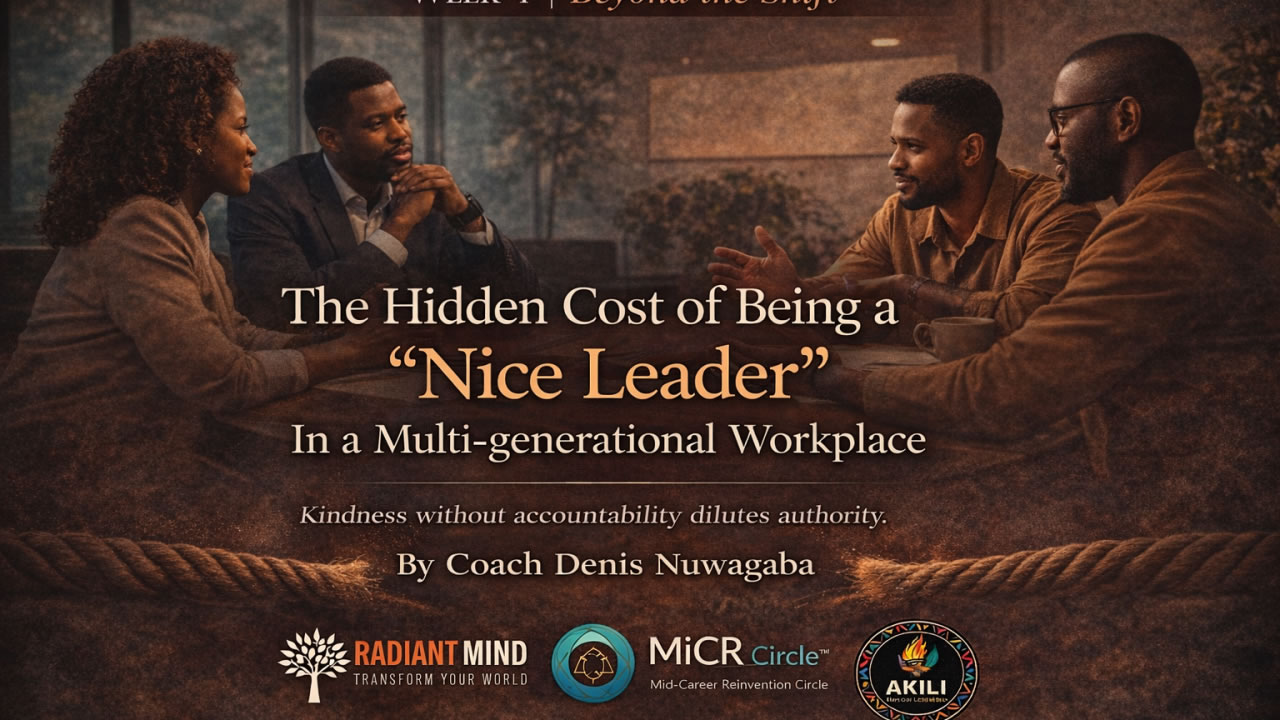
By Coach Denis Nuwagaba
“Effective leadership is not about making speeches or being liked; leadership is defined by results, not attributes.” — Peter Drucker
In last week’s column, we explored Why High-EQ Leaders Still Struggle with Feedback, noting that empathy without resilience often leads to a “feedback gap.” This week, we dive deeper into a related trap: the lure of being the “Nice Leader.”
In today’s multi-generational landscape—where Baby Boomers, Millennials, and Gen Z collide—the “nice” leadership style has become a popular default. But is your kindness building a bridge or a barrier to excellence?
The “Nice” Trap: When Harmony Hinders Performance
Being a “nice leader” typically means prioritizing empathy, patience, and a non-confrontational atmosphere. On the surface, this fosters a positive culture. However, when “nice” becomes a leader’s primary identity, it often comes at a hidden cost: the dilution of authority.
When we over-index on likability, we inadvertently create:
- Blurred Boundaries: Professional standards become suggestions rather than requirements.
- Inconsistent Accountability: Rules are enforced sporadically to avoid “hurting feelings.”
- Perceived Weakness: Particularly for Gen Z—who value radical transparency and directness—excessive niceness can be interpreted as a lack of authenticity or a “hidden agenda.”
Why We Choose “Nice” (And What It Costs Us)
Most leaders lean into niceness to foster trust and reduce resistance. We want to be the “approachable” boss. But the bill for this comfort eventually comes due.
When you avoid the “tough” conversation to keep the peace, you aren’t being kind; you are being conflict-avoidant. The cost is a culture of mediocrity where underperformance is tolerated, and high-achievers become frustrated by the lack of discipline. For a Gen Z professional seeking rapid growth, a leader who is too “nice” to give stinging, but necessary feedback is a leader who is stalling their career.
Red Flags: Has Your Kindness Crossed the Line?
How do you know if your leadership has shifted from supportive to ineffective? Watch for these warning signs:
- The Silence of Issues: You consistently avoid tough talks, even when KPIs are tanking.
- The Policy Slide: You make so many “exceptions” that the original policy no longer exists.
- The Feedback Fog: Your team expresses confusion about their performance despite “good vibes” in the office.
- The Engagement Paradox: Morale seems high in person, but results and genuine engagement are trending downward.
Striking the Balance: Compassionate Assertiveness
The goal isn’t to become a tyrant; it’s to marry kindness with firmness. To lead a multi-generational team effectively, you must master the art of being “Kind but Clear.”
- Set the Guardrails early: Establish clear expectations and non-negotiable standards from day one.
- Normalize Radical Candor: Move from “nice” to “kind” by providing honest, frequent, and constructive feedback.
- The Two-Way Street: Especially with Gen Z, foster an environment where they can hold you accountable too. This builds a respect-based hierarchy rather than a fear-based or “friend-based” one.
Conclusion
Kindness is a leadership superpower, but only when anchored by the weight of accountability. As our workplaces become more diverse, the leaders who thrive will be those who realize that the “nicest” thing you can do for your team is to lead them toward growth—even when that journey requires a little friction.
Join the Debate:
- Is there such a thing as being “too nice” in leadership?
- How do you maintain discipline without losing your approachability?
- Have you ever seen a leader’s “niceness” sabotages a team’s success?
Share your thoughts in the comments below!
About the Author
Denis Nuwagaba is a Career Transition Strategist and Transformation Leadership Coach. He is a Core Team Member of the Radiant Mind Africa – AKILI (Africa’s Key Innovative Leadership Incubator) NextGen Leadership Program.