In our previous discussion, we explored why high-purpose leaders choose to walk away: The Cost of Moral Friction. We identified that when the “Why” is consistently sacrificed for the “Margin,” your most committed people don’t just burn out—they check out.
But here is the deeper tragedy: Most organizations don’t even know their best leaders are struggling until the exit interview.
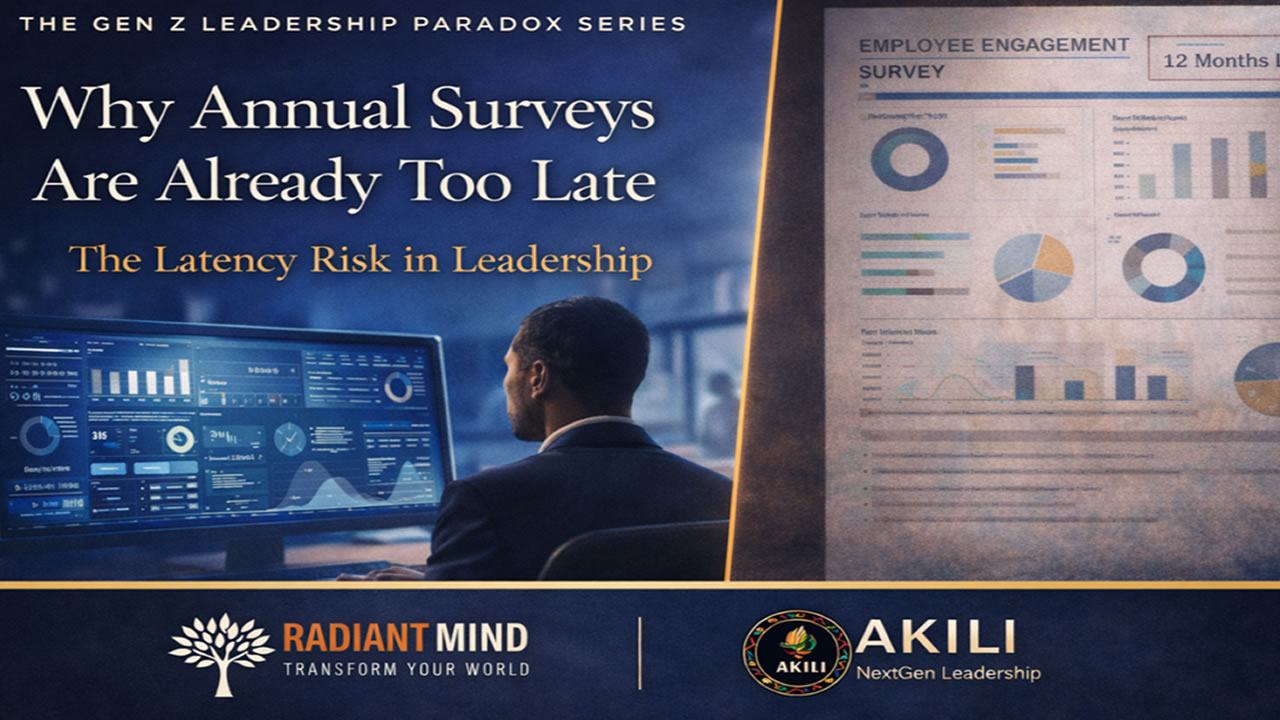
Every year, organizations follow the same ritual: engagement surveys, culture audits, and satisfaction questionnaires. Thousands of data points are harvested, reports are polished, and leadership retreats to “action plan.”
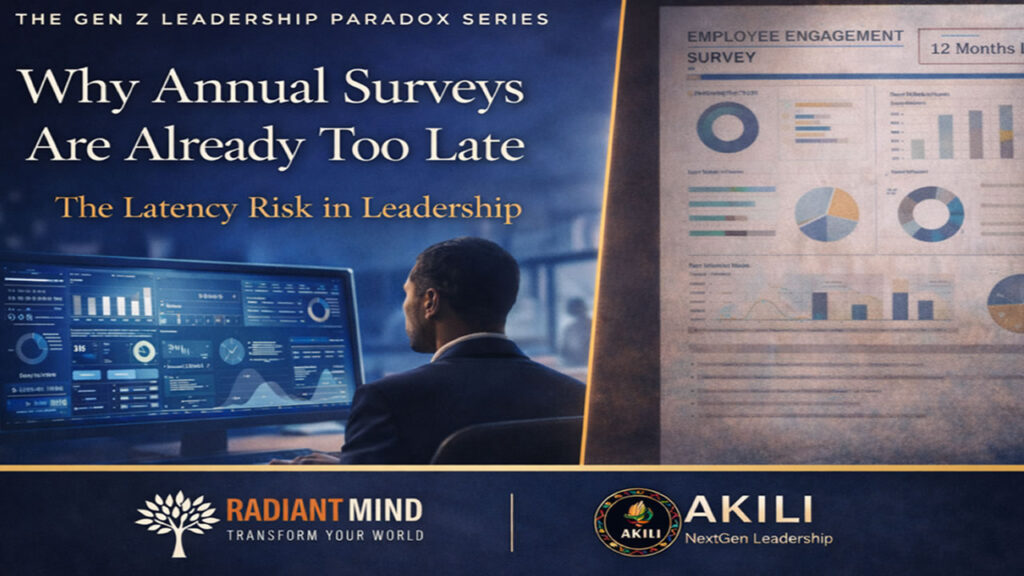
But as we continue our series on The Gen Z Leadership Paradox, we must confront a fundamental flaw: By the time you analyze the results of an annual survey, the moment that created the problem has already expired.
1. The Speed of Organizational Reality
Modern business moves at a tempo that “once-a-year” data simply cannot catch. In the time it takes to distribute and analyze a survey, teams have restructured, projects have pivoted, and managers have shifted roles.
Imagine managing your company’s finances using data that is 12 months old. No executive would accept that as a basis for decision-making. Yet, when it comes to the Resonance of your culture—the very engine of your performance—many organizations are still managing by looking through the rear-view mirror.
2. The Gen Z Factor: Real-Time or No Time
For Gen Z, the first generation of true digital natives, the “refresh” button is a way of life. They live in a world of continuous feedback and instant response.
To a Gen Z employee, a 12-month feedback cycle isn’t just “slow”—it’s a signal. It tells them that leadership is disconnected, bureaucratic, and perhaps worst of all, indifferent. In their world, silence from leadership is interpreted as a lack of care. If they have to wait a year to be heard, they won’t wait at all; they’ll find a “Safe Harbor” elsewhere.
3. The “Rear-View Mirror” Problem
Relying on historical sentiment creates three critical leadership blind spots:
● Silent Disengagement: People rarely quit overnight. They disengage through a series of small, unaddressed moments—a dismissed idea, a slight misalignment in purpose. By the time a survey captures this “Quiet Quitting,” the emotional damage is often irreversible.
● Lagging Leadership Response: The survey identifies the fire, but only after the building has burned down. Identifying a “decline in trust” six months after the friction started is not leadership; it’s an autopsy.
● Culture Drift: Culture doesn’t collapse; it drifts. Meetings become less authentic, and leaders stop asking difficult questions. Because annual surveys are infrequent, these subtle shifts go unnoticed until the core values have eroded.
4. From Harvesting Data to Active Listening
At Radiant Mind Africa, we believe that winning the talent war requires shifting from periodic monitoring to Continuous Listening.
This involves moving toward Frequent Pulse Surveys—short, monthly check-ins that turn data into trends. But even more importantly, it requires Psychological Safety. Great leaders are shifting their focus to Active Observation: measuring the energy in meetings, the tone of digital conversations, and the openness of daily discussions.
The Bottom Line
The question for modern leaders is no longer: “What did the annual survey say?” The only question that matters for your Intellectual Authority is: “What are our people experiencing right now?”
Let’s keep the conversation going:
Is your organization still managing culture in the rear-view mirror? How do you capture the “unspoken tension” in your team before it leads to an exit?
Share your thoughts below. Let’s move #BeyondTheShift.
About the Author Roselynn Wekikye (Leen) is a Leadership Development Specialist and a Core Team Member of the Radiant Mind Africa – AKILI (Africa’s Key Innovative Leadership Incubator) NextGen Leadership Program. She is dedicated to helping organizations build real-time feedback loops and resilient leadership cultures.